The Atelier as a living Guild practice
Companion, artist and print maker David Borrington writes about the philosophy that inspires his work and that of his fine art Atelier, Dekkle, which specializes in Intaglio, Relief, Stone Litho, and Digital to Analogue printing, blending tradition with modern techniques. and
The Atelier as a Living Guild Practice
As Companions of the Ruskin Guild, we are not simply caretakers of an idea, but participants in something still active. Ruskin was never interested in reverence without practice. What mattered to him was how thought lived in the world, through labour, education, and the conditions under which work was made.
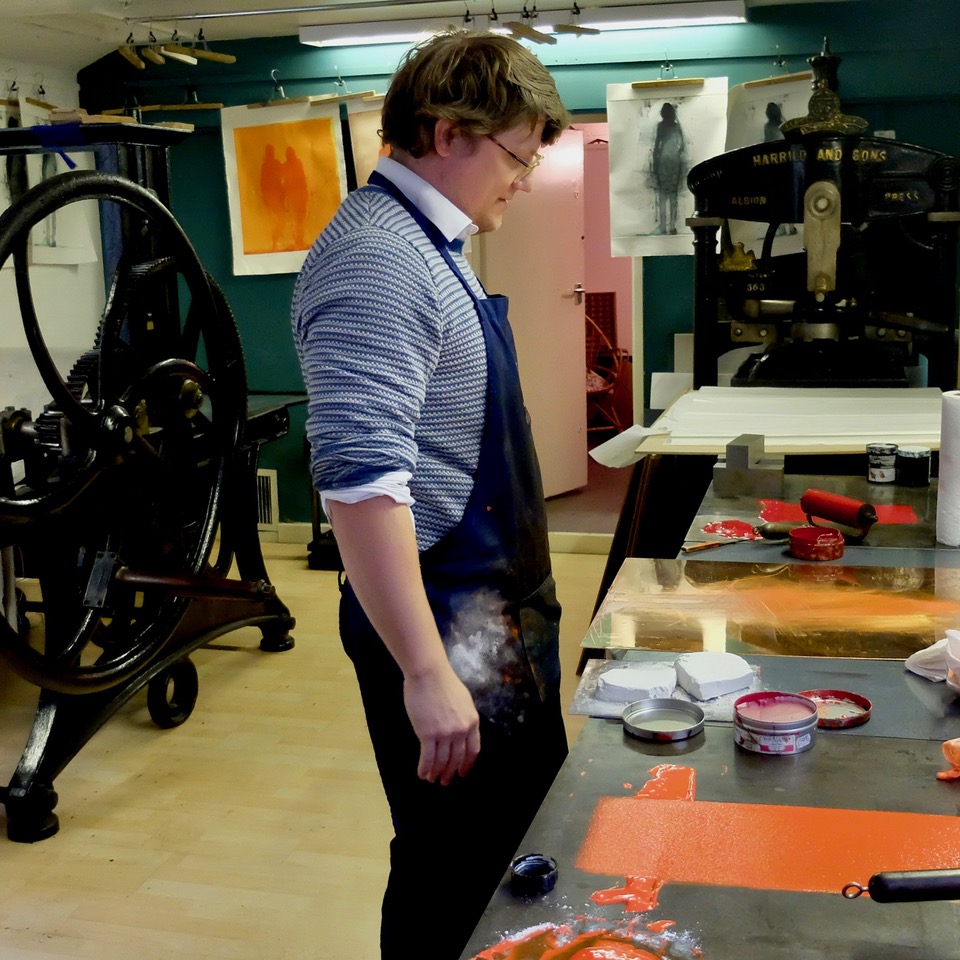
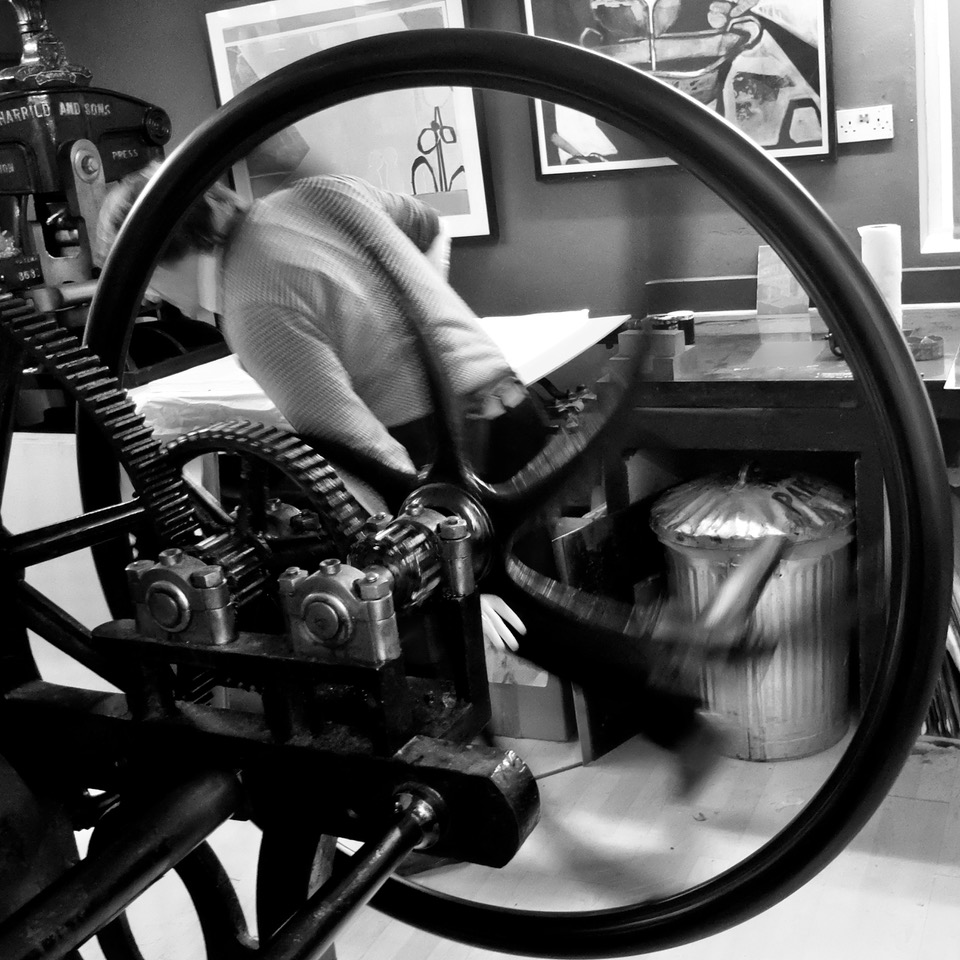
My own studio operates very much in that spirit. It is a small printmaking atelier, not because it has ambitions to grow into something larger, but because its scale is intentional. It allows for attention to materials, to process, and to the relationship between making and thinking. In that sense, the studio functions less as a conventional business and more as a working continuation of guild principles.
Strictly speaking, it is probably not a business at all. My accountant would certainly agree with that, as would my bank account. And yet, somehow, we make it work. Not because it is efficient, but because it is necessary. Making, teaching, and thinking still need physical spaces in which to happen properly.
Printmaking sits naturally within this tradition. It is a craft grounded in discipline and repetition, yet inherently social. Prints are made to move. They circulate ideas without surrendering the integrity of the work. William Morris understood this instinctively. His commitment to beauty was never separated from access, nor was his politics divorced from labour. For Morris, the act of making was already a social position.
My own print practice often engages with social and political themes, but it does so through process rather than declaration. Printmaking slows thought down. Decisions carry weight, and once made, they remain visible. That constraint encourages reflection rather than reaction, which feels increasingly important in the present climate.
Alongside the atelier, we run a small independent art school offering tuition in both traditional and contemporary printmaking. The emphasis is not on novelty or professional packaging, but on transmission. Skills are learned through observation, shared problem-solving, and time spent working in close proximity to experienced practice. This model owes far more to the workshop and the guild than to modern institutional teaching.
William Morris believed that education separated from making diminished both. That belief underpins the studio’s approach. Students are not treated as consumers or future outputs, but as makers entering into a relationship with materials, history, and responsibility.
Independence is central to this way of working. Operating outside large institutions allows the studio to remain faithful to processes that take time and resist efficiency. It also allows space for political and philosophical work that is thoughtful rather than didactic. The studio does not exist to reinforce consensus, but to encourage clarity.
Importantly, the atelier is not a closed space. It is open to Companions and members of the Ruskin Guild. Whether through visiting, working, teaching, or simply talking, the studio is intended as a place of exchange. A contemporary workshop where ideas, skills, and concerns can be shared across practices and generations.
In an age dominated by scale and abstraction, the small atelier remains quietly purposeful. It insists that value lies in attention, that learning requires presence, and that craft is not a retreat into the past, but a living continuity.
If the Guild endures, it does so not only through formal structures, but through places like this. Modest rooms where work is visible, knowledge is passed on, and making remains inseparable from thought.